
Blogpost Keywords: Napoleon style brass ceiling pendant light, hanging brass pendant lamp, empire pendant ceiling light
A Napoleon style brass ceiling pendant light does something few fixtures manage — it draws the eye upward without demanding the visual real estate of a full chandelier. Borrowing from French Empire design vocabulary, these pendants pair disciplined geometry with the inherent warmth of brass, making them a natural fit over kitchen islands, dining tables, and entryway consoles. The challenge lies in choosing one that balances proportion, finish quality, and practical lighting performance.
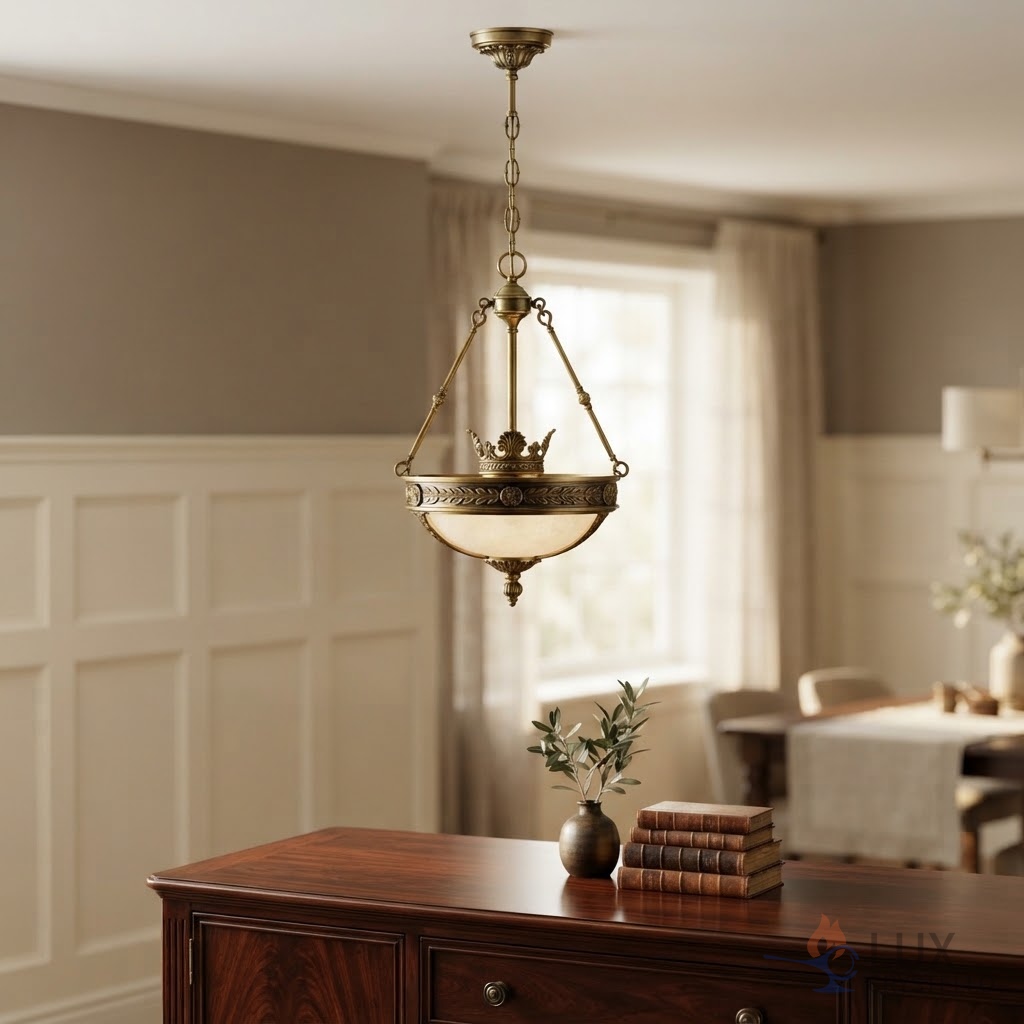
What Makes a Napoleon Style Brass Ceiling Pendant Light Different
Unlike generic brass pendants, Napoleon style versions incorporate specific design markers: symmetrical arm curves, urn-shaped bodies, classical finials, and sometimes etched or frosted glass shades. These details elevate the fixture beyond simple task lighting into decorative territory. A hanging brass pendant lamp in this style carries more visual weight than a minimalist globe pendant, which is precisely the point in rooms that need a focal element.
The market for a Napoleon style brass ceiling pendant light is crowded, and many sellers attach “Napoleon” or “Empire” labels to fixtures that share only a passing resemblance. A genuine Napoleon style piece will show proportional discipline — the canopy, chain, and shade relate to each other in a structured way, not randomly assembled. An empire pendant ceiling light from a reputable maker will also have consistent finish quality across all components.
Sizing and Placement for Different Rooms
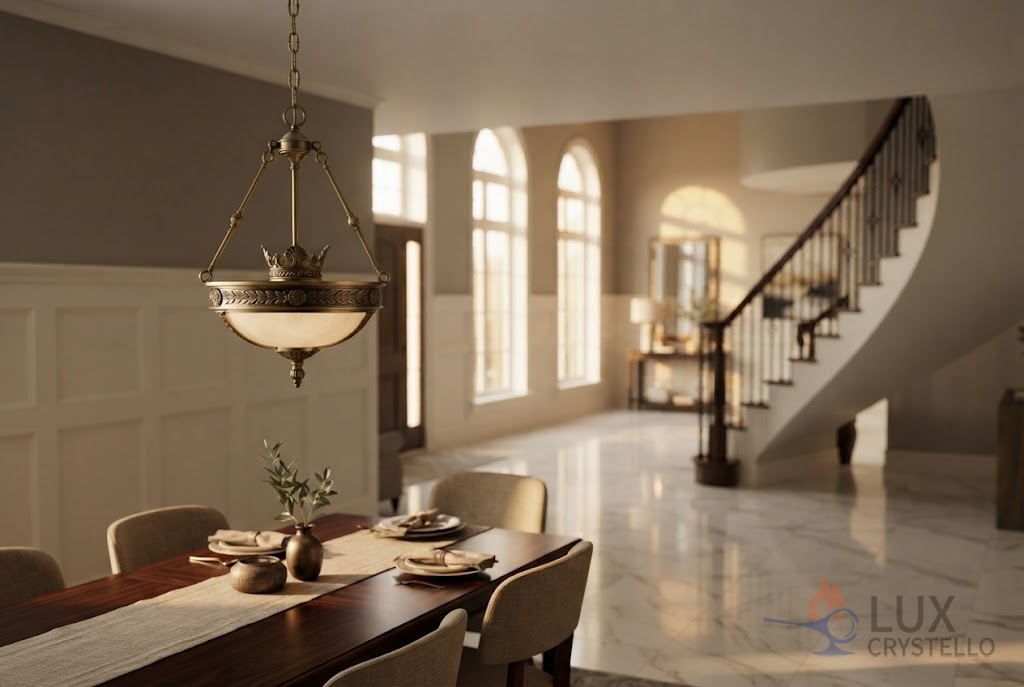
Over a dining table, a Napoleon style brass ceiling pendant light should hang roughly 30 to 36 inches above the tabletop. This keeps the fixture close enough to create intimacy without blocking sight lines across the table. For kitchen islands, 36 inches is the safer minimum. Getting the height wrong is one of the most common mistakes buyers make — too high and the fixture looks disconnected, too low and it interferes with daily use.
Diameter matters too. A hanging brass pendant lamp that is too small over a 72-inch dining table looks like an afterthought. As a rough rule, the pendant’s diameter in inches should be about half to two-thirds the table width. An empire pendant ceiling light in the 16-to-22-inch range typically handles most standard dining setups. For larger tables or open-plan rooms, consider grouping two or three smaller pendants rather than one oversized fixture.
Comparing Pendant Styles: Single vs. Multi-Light
Single-light pendants work well in series — three hung in a row over a kitchen island, for example — while multi-light pendants (three or five arms radiating from a central canopy) deliver more impact as standalone pieces. The trade-off is ceiling load: multi-light brass pendants are heavier and may require reinforced mounting for older homes. A Napoleon style brass ceiling pendant light with five arms provides ambient lighting for an entire dining area.
A practical consideration is the light spread. A single pendant casts a focused pool of light, which suits task-oriented spaces. A multi-arm Napoleon pendant distributes light more evenly, functioning closer to ambient lighting. Neither is inherently better — the choice depends on whether the fixture serves a functional or decorative primary role. A hanging brass pendant lamp over a reading nook needs focused output, while an empire pendant ceiling light over a foyer needs broader coverage.
Bulb Compatibility and Dimming
Most Napoleon style brass ceiling pendant lights ship with candelabra (E12) sockets, which historically limited buyers to incandescent flame-tip bulbs. Today, LED candelabra bulbs in warm white (2700K) replicate that glow at a fraction of the energy cost. Some newer models accept standard E26 medium-base bulbs, which broadens the LED selection considerably.
Dimmability is worth confirming before purchase. Not all LED bulbs dim smoothly, and pairing a non-dimmable LED with a dimmer switch produces flicker and premature bulb failure. Ask the seller to specify the compatible dimmer type — leading-edge or trailing-edge — to avoid the mismatch that frustrates many first-time buyers.
Single-Light vs. Multi-Light Pendants
| Feature | Option A | Option B |
|---|---|---|
| Light Spread | Focused, task-oriented | Distributed, ambient |
| Ideal Use | Kitchen island (in series) | Dining table, foyer |
| Ceiling Load | Lighter, easy install | Heavier, may need support |
FAQ
Can a Napoleon style brass ceiling pendant light work in a bathroom?
Yes, but placement matters. Keep it away from direct water exposure — over a freestanding tub or in a powder room works well. Verify the fixture is rated for damp or wet locations if humidity is a concern.
How long should the chain or rod be?
Most Napoleon pendants ship with adjustable chains or rods. For standard 8-to-9-foot ceilings, a 12-to-18-inch drop is typical. Higher ceilings may need longer extensions, which many manufacturers offer as add-ons.
Are replacement glass shades available?
Reputable brands sell replacement shades separately. Before buying, confirm the shade fitting type — fitter, holder, or threaded — so replacements match without modification.
Conclusion
A Napoleon style brass ceiling pendant light bridges the gap between functional task lighting and decorative statement piece. Its Empire-inspired geometry adds character to dining areas, kitchens, and entryways without the spatial demands of a full chandelier. Getting the size, height, and bulb pairing right ensures the fixture earns its place for years.
Choosing Your Next Pendant With Confidence
Napoleon style brass ceiling pendant light options vary widely in quality and price. Start by measuring the intended space — table width, ceiling height, and available clearance. Then compare finishes across at least three sellers. A hanging brass pendant lamp that looks identical in photos may differ significantly in weight, shade quality, and socket type once it arrives.