
Blogpost Keywords: brass and glass wall light, glass wall sconce, brass corridor lighting
A brass and glass wall light solves a problem that overhead fixtures ignore: it puts gentle, glare-free illumination exactly where people walk, sit, and pause. Mounted at eye-adjacent height, it turns a bare wall into a source of ambience rather than a flat surface waiting for art.
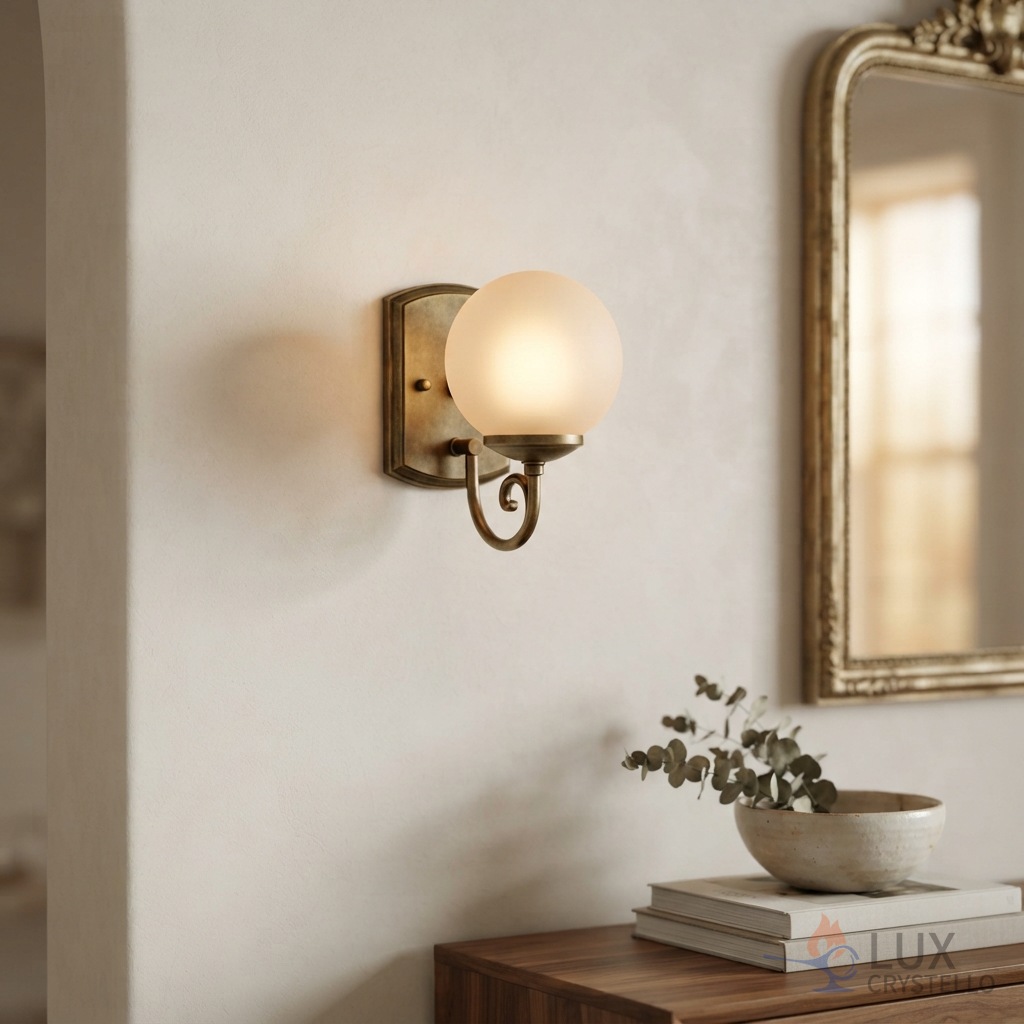
Where a Brass and Glass Wall Light Works Best
The most obvious home is the hallway, but the same logic applies to a staircase landing, a bathroom mirror, or the sides of a fireplace. A glass wall sconce throws a soft pool of light that flatters skin tones near a vanity, which is why designers reach for it in powder rooms more than any other room.
Brass and glass also pairs with the materials already in most homes. Against painted drywall the metal reads as jewelry; against tile it reads as intentional hardware. A practical consideration is the bulb’s position — a shade open at the bottom casts down, while a closed globe spreads evenly in every direction.
A brass and glass wall light also earns a spot beside a bed, where a low glass wall sconce throws a soft pool for nighttime without waking a partner.
Hardwire, Plug-In, or Battery
Three mounting paths exist, and the choice shapes everything else. Hardwired units look built-in and permanent; plug-in versions clip to a visible cord; battery or rechargeable pucks avoid wiring entirely. Horizontal comparison: hardwire wins on clean looks but needs an electrician, plug-in wins on rental freedom but shows a cord, battery wins on placement but needs charging.
For brass corridor lighting that runs a long stretch, hardwire is usually the only sane choice — running cords down a 20-foot hall reads as unfinished. In a rented apartment, a pair of plug-in sconces with a discreet cord cover is the compromise most people actually keep.
A brass and glass wall light on hardwire looks built-in and pairs naturally with brass corridor lighting that runs the length of a hall.
| Factor | Hardwire | Plug-In |
|---|---|---|
| Installation | Electrician required | Outlet, no wiring |
| Look | Seamless, permanent | Cord visible |
| Best use | Hallways, stairs | Rentals, accents |
Finish and Glass Choices
Polished brass feels formal; antique brass feels collected. The glass matters as much as the metal: clear glass shows the bulb, frosted glass hides it, and seeded glass adds a subtle texture that reads expensive without trying. Buyers often regret clear glass only after seeing the bare filament at night.
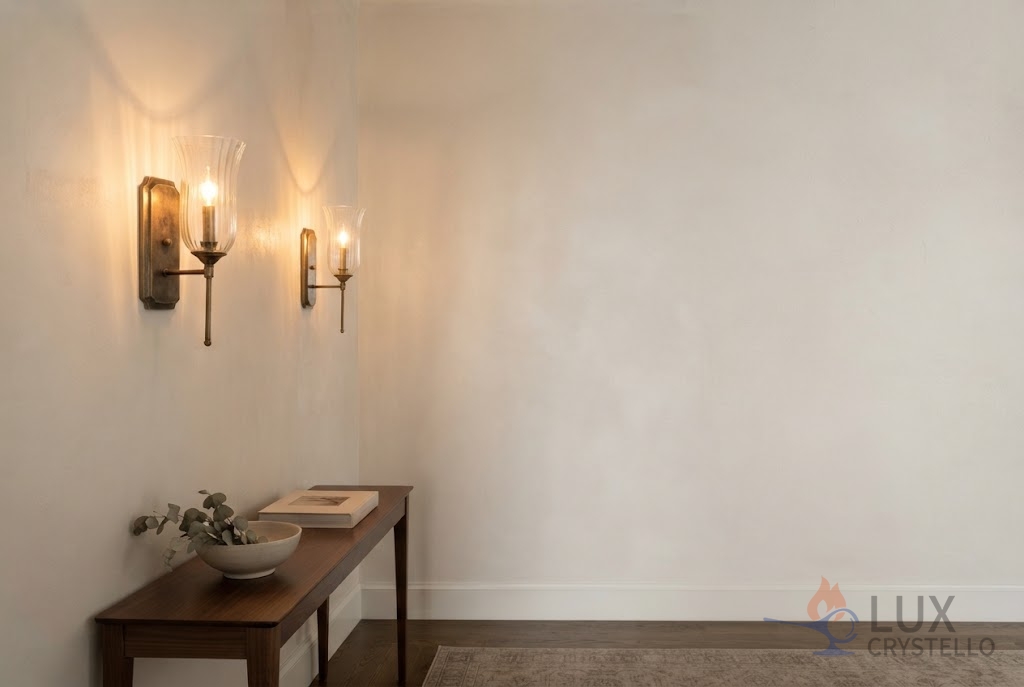
One detail that surprises people: a brass and glass wall light placed too high throws light onto the ceiling instead of the face or floor. A glass wall sconce in frosted glass suits a bathroom mirror, while brass corridor lighting in a hallway benefits from a clear shade that shows the warm filament. Aim the center of the shade around 60 to 66 inches from the floor for most spaces, then adjust by the room’s actual use.
A Note on Pairing and Spacing
Sconces read best in twos. A single wall light can look like a leftover; a matched pair frames a mirror or a piece of art with intention. Space pairs evenly and keep them clear of door swings and switch plates so the installation looks planned rather than crowded.
A brass and glass wall light looks most intentional when its pair is mirrored exactly, the way brass corridor lighting repeats at even intervals down a long wall.
Wiring, Switching, and Long-Term Upkeep
Switching is the detail most people postpone until the electrician is already on site. A wall control near the doorway suits a corridor; a switch built into the fixture body suits a bedside pair, where crossing the room to turn off a light defeats the purpose. In practice a dimmer earns the extra fifteen minutes of labour, because the same fitting that feels welcoming at full output becomes a night light at twenty percent, and warm-dim LEDs shift slightly amber as they drop, which lands closer to candlelight than a flatly dimmed white.
Upkeep depends almost entirely on the finish. Lacquered metal wants nothing more than a dry microfibre cloth, and abrasive polish will cut through the coating to leave a dull patch that cannot be buffed back. Unsealed brass behaves the opposite way: it darkens unevenly where hands touch it, and owners either learn to like that map of use or polish it every few months. The glass collects dust faster than the metal does, so plan on lifting a glass wall sconce shade off twice a year rather than wiping it in place.
One more practical point: check the backplate diameter against the junction box before ordering. A narrow backplate on an older octagonal box leaves a visible gap, and the usual fix, a paintable extension ring, is far easier to buy in advance than mid-install. Brass corridor lighting fitted along an older hallway meets this problem more often than people expect, because boxes from different decades rarely line up.
FAQ
Can a brass and glass wall light go in a bathroom?
Yes, in zones away from direct water, and only with a damp-rated model. Always check the rating before mounting near a shower or tub.
Do I need an electrician to install one?
Only for hardwired units. Plug-in and battery versions can be placed by the homeowner, though hardwire gives the cleanest result.
What bulb brightness should I pick?
Around 200 to 400 lumens per sconce at 2700K warm white is enough for ambience without overwhelming a small room.
Will brass tarnish near humidity?
Lacquered brass resists tarnish; unsealed brass will patina. In humid rooms, a sealed finish is the lower-maintenance choice.
Conclusion
A brass and glass wall light is one of the few upgrades that improves both function and mood at once. Choose the mount type to match your housing situation, place the pair with intention, and the wall starts working for the room.
Bring the Look Home
Before you order, measure the wall and decide whether wiring is on the table — that single choice narrows the field fast. A thoughtfully placed brass and glass wall light makes a hallway feel designed, and getting the height right is the difference between awkward and elegant.